


10 Most Frequent Boiler Issues
Having a boiler issue can be quite frustrating, especially in the winter. If boilers aren’t frequently serviced, they might experience a variety of problems, from leaks to cold radiators. Fortunately, a Gas Safe Registered engineer can quickly diagnose and solve the majority of the most prevalent problems.
Boiler Leaks
A boiler leak is among the most typical boiler problems. Leaks can be a hassle since, in addition to resulting in water damage to a property, they can also lead to the failure of electrical parts inside and next to the boiler.
Several factors can cause a boiler to leak:-
- Too much boiler pressure
- Corroded tanks or pipes
- A defective component
- Leaking seals
Always regard a leak as a significant problem. Call a licensed heating engineer as soon as you discover a leak so they can look into it. To locate the leak’s source, do not try to remove the boiler casing yourself.
No Heating But Hot Water
People frequently have boiler problems when their property has hot water but no central heating. There are several potential causes for this. First off, a combi boiler may unintentionally be configured to merely heat the water and not the central heating if you have one. This may occur if the boiler is left running in this mode during the summer when the radiators don’t need to be heated. The boiler might potentially be programmed to start at an unexpected moment. To see if this is the case, check the boiler display.
Another possibility is that the boiler is operating normally, but the radiators are unable to heat up because of trapped air. Bleeding the radiators will allow the trapped air to escape the system, which is the answer in that situation.
Even when you have hot water, if your central heating still won’t switch on, there may be a problem with the boiler or heating system. A Gas Safe certified engineer can look into the problem and identify its root cause.
Minimal Boiler Pressure
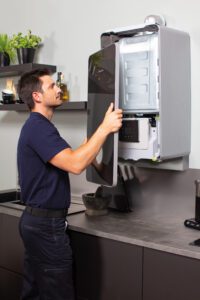
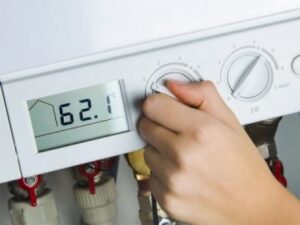
Lack of hot water and cold radiators can result from low boiler pressure. Low boiler pressure can be seen on the boiler display panel, where a physical or digital dial will indicate the system’s pressure. The boiler manufacturer and type will determine a minor variation from the most normal pressure level of 1.5 bars. There are two primary causes for pressure drops in boilers:
If there is a leak in the system, there won’t be enough water, which will cause the pressure to fall.
Additionally, a bleeding radiator might lower system pressure.
Re-Pressurising the boiler can restore low boiler pressure. To do this, the boiler filling loop must be opened to let water back into the system.
Boiler Kettling
Kettling is yet another frequent boiler issue. When water is heated too quickly to the point of boiling, air becomes trapped and steam is produced, leading to boiler kettling. The compressed air makes a kettle-like whistling noise.
Limescale accumulation, which slows the flow of water and causes it to heat up too much, can result in boiler kettling. The appliances malfunctioning part could result in the boiler heating the water to higher temperatures than usual.
A boiler engineer may examine the system and determine what is causing the kettling. Depending on how serious the issue is, there is a solution. Sometimes the noisy component can just be cleaned differently, while other times it can be necessary to replace the parts.
Frozen Condensate Pipe
During the colder months, a frozen condensate pipe is a problem that many people encounter. Every condensing boiler has a pipe leading outside the building to carry the wastewater generated during the condensing process. The condensate pipes water may freeze in the event of a temperature dip below zero, causing the system to automatically shut off as a precaution.
Pouring warm water over a frozen condensate pipe will help it thaw the fastest. By allowing waste water to leave the pipe, the boiler should be able to restart. Check out our tutorial on how to safely unfreeze a condensate line for more information on this.
Unresponsive Boiler Thermostat
Homeowners can choose from a variety of thermostats to assist improve the efficiency of their dwellings. Although these thermostats often function flawlessly, it can be annoying if the boiler suddenly stops reacting to the thermostat.
Check if the temperature on the thermostat is higher than the ambient room temperature if you suspect that your boiler is no longer operating with the thermostat. If it isn’t, the thermostat is probably in good shape.
Try changing the thermostat batteries or repositioning it closer to its receiver if the room temperature is below the set temperature. If this doesn’t work, it’s possible that the thermostat needs to be changed since it is broken.
No Hot Water Or Heating
There is clearly a problem with the system if your boiler has left you without heating or hot water. Several factors might cause a boiler to stop producing hot water or central heating:
- Power, gas, or water have all been cut off to the boiler. These connections may become disconnected unintentionally or as a result of a power loss.
- Lack of heat and hot water results from the system turning off automatically if the boiler pressure rises or falls too high or too low.
- An airlock or frozen condensate pipe can cause piping problems that prevent a boiler from operating.
- Along with other safety features that are incorporated into the appliances and show additional flaws.
It’s always advisable to get a Gas Safe Registered professional to assess the boiler and address any problems that may be causing a shortage of hot water or central heating.
Boiler Repeatedly Turns Off
A boiler may eventually start to abruptly shut off if it is not regularly maintained. There are several possible explanations for this, including:
- Air trapped in the system
- Minimal boiler pressure
- Boiler pressure is high
- Defective thermostat
- Sludge and debris are accumulating in the pipes.
One of these flaws may be the reason for your boiler turning on and off repeatedly. A competent heating engineer will be able to determine the severity of the issue and whether a new boiler is required or whether it can be fixed.
Unexpected Boiler Noises
A boiler can create a broad variety of odd noises in addition to kettling:-
Gurgling sounds are an indication that the system has trapped air.
Drone noises are typically the result of a damaged pump.
Humming sounds – this typically occurs if water pressure from the mains is too high.
Whooshing sounds happen when dust or debris clogs the air filters in the system or when the air intake line is clogged by material.
Unusual boiler noises are typically not a sign that the system is in immediate danger. However, it is best to contact an experienced heating engineer right away to conduct an investigation.
Burning Out A Pilot Light
An older boiler could have a pilot light that needs to be kept burning all the time in order to light the larger boiler burner. Over time, components that are essential for igniting the pilot switch may develop faults.
Do not attempt to fix or replace your pilot light if it continues going out. Since doing so would necessitate removing the boiler casing, doing so would be against the law unless you are a member of the Gas Safe Register. Instead, make sure all of your other gas appliances are operating properly first. If not, there might be a problem with the gas supply itself.
Call a Gas Safe Registered engineer to diagnose and fix the issue if the other gas appliances are operating properly. Modern boiler types do not have pilot lights, so they are not affected by this problem.
Summary
A variety of issues can arise with boilers, the most of which should be handled by a licensed boiler expert.
Leaks from boilers need to be taken seriously and fixed right away.
The radiators may need to be bled if the central heating is not working.
Leaks can contribute to low boiler pressure, which can be fixed by opening the filling loop.
Boiler kettling can be very noisy and occasionally calls for the system to be cleaned or a component to be changed.
Warm water can help defrost frozen condensate pipes.
If a thermostat batteries are dead or it is too far away from the boiler, the boiler may not react.
A boiler engineer is obviously required if there is a problem with the central heating and hot water.
An expert will be able to determine whether a part needs to be replaced or if the entire boiler needs to be replaced if a boiler keeps shutting off. This can sometimes be more economical.
Numerous unusual and annoying noises, like gurgling and buzzing, can be produced by boilers.
Never try to swap out any parts on your own. The best person to securely fix any difficulties is a professional heating engineer and CK Plumbing & Heating can help with all of your boiler issues. Call us today.